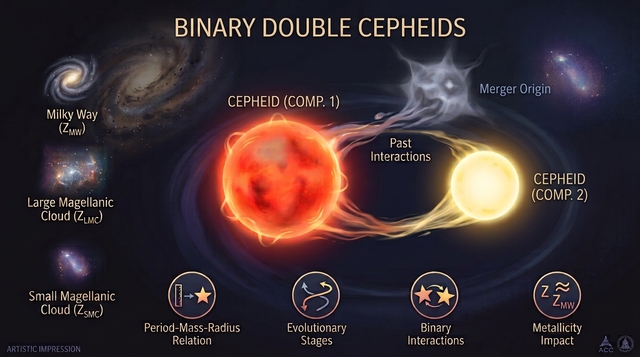
Binary double (BIND) Cepheids are systems comprising two Cepheid components. This feature provides important constraints that allow us to determine the origin of Cepheids, to trace their evolution, and to test pulsation theory. Ten BIND Cepheids are now known, only one of which has its parameters determined. In five systems, the difference between the pulsational periods of Cepheid components is unusually high.
Our aim is to estimate the physical parameters of the components of nine BIND Cepheids newly identified in the Magellanic Clouds and the Milky Way, and to investigate their evolutionary configurations and formation scenarios. We also expand the parameter space of characterized individual Cepheids in mass, radius, period, and metallicity.
To achieve these goals, we extended the recently introduced method to BIND Cepheids, combining observational constraints with theoretical pulsation and evolutionary models. With the pending determination of the spectroscopic mass ratio (qs), we used the pulsation periods of both components in its place. We considered all consistent configurations (first-crossing, blue loop, and mixed) as viable solutions. Probabilistic and observational constraints, including spectroscopic mass ratios for two systems, were then used to discriminate between them.
We obtained new q-PED estimates of mass, radius, temperature, luminosity, and age for 18 Cepheids with previously unknown physical parameters. For one Galactic system, the spectroscopic mass ratio qs=0.84±0.04 indicates a first-crossing plus a blue loop Cepheid solution. This mass ratio, along with the predicted mass ratios lower than unity for three other systems, suggests past binary interactions, most likely a merger origin for one of the components. In addition, we derived a new period-mass-radius relation and fit a mass-luminosity relation covering the mass range 2.3-4.6 M⊙ that clearly distinguishes between different crossings of the instability strip.
This work provides the first mass estimates for Cepheids in the SMC, extending the lower Cepheid mass limit down to 2.3 M⊙. For the benchmark eclipsing Cepheid OGLE-LMC-CEP-1718, pulsationally driven mass loss may account for its unexpected, reversed mass ratio. Binary interactions in the past evolution of Cepheids may be common, affecting up to 40% of our systems with two clear cases and two more if blue loop Cepheids are preferred. Improved spectroscopic mass ratios from ongoing observational campaigns will gradually clarify the evolutionary history for all presented BIND Cepheids.