 |
Catalogs
Cepheid Phys. Properties
Binary Cepheid Solutions
Projects
SB2 Cepheids
Classical Cepheids
Type II Cepheids
Papers
by category
by first author
by target
Visitors so far: 178231.
|
|
Catalogs
Cepheid Phys. Properties
Binary Cepheid Solutions
Projects
SB2 Cepheids
Classical Cepheids
Type II Cepheids
Papers
by category
by first author
by target
Visitors so far: 178231.
Relevant publication:
2025, ApJL, 981, L35 (← click to see the publication at ADS/arXiv)
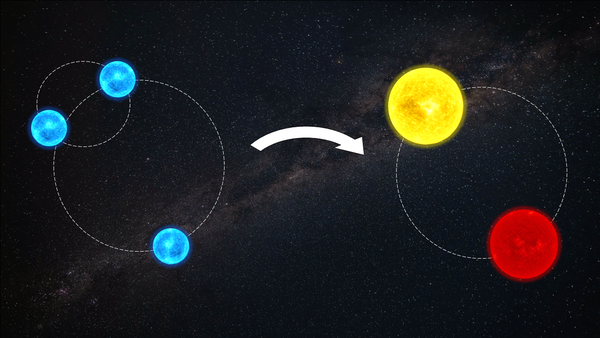
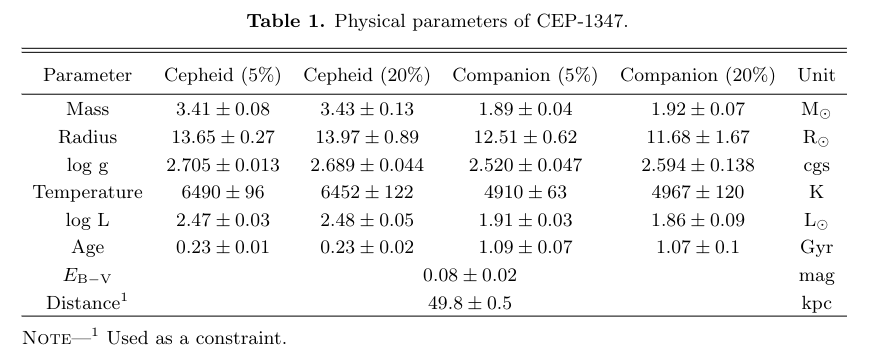
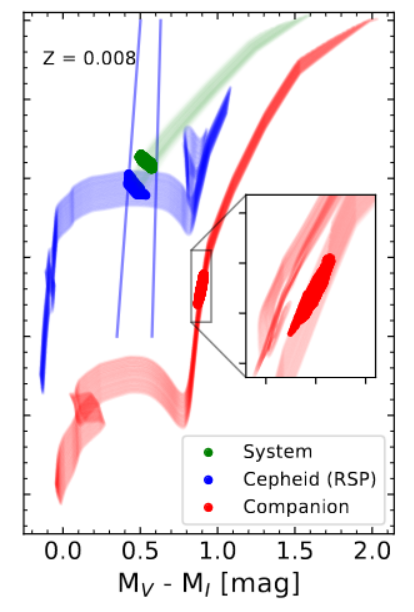
Recently, a double-lined binary (SB2) classical Cepheid, OGLE-LMC-CEP-1347, was discovered, with the orbital period (Porb = 59 days) five times shorter than of any binary Cepheid known before. The expected mass of the Cepheid was below 3.5 M⊙, which, if confirmed, would also probe the uncharted territory. The system configuration also pointed to the Cepheid as a merger. We present a novel method for determining precise physical parameters of binary Cepheids using both theory and observations. This q-PED method combines the measured mass ratio (q), pulsation (P), and evolutionary (E) models, and the known distance (D) supplemented with multi-band photometry. Applying it, we determined the mass of the Cepheid of 3.41 ± 0.08 M⊙, its radius of 13.65 ± 0.27 R⊙, the companion mass of 1.89 ± 0.04 M⊙ and radius of 12.51 ± 0.62 R⊙.
 |
|---|
With the current configuration, the apparent evolutionary age difference of almost 1 Gyr between the components strongly favors the Cepheid merger origin scenario. If so, the actual age of the Cepheid would be 1.09 Gyr, closer , indicating a significant fraction of Cepheids may be much older than typically assumed. We also applied our method to an eclipsing binary Cepheid OGLE-LMC-CEP-1812 with accurately determined physical parameters, obtaining a close agreement, which confirmed our method’s reliability.
 |
|---|