Exoplanet demographics across Galactic birth radii
This work investigates the history of how stars travel throughout the Galaxy, having interactions with structures such as the bar, spiral arms, and giant molecular clouds. In particular, we explore the impact of these events may have on planetary systems.
We constructed a homogeneous catalogue by cross-matching the Encyclopaedia of Exoplanetary Systems with Gaia astrometry and infrared photometry from 2MASS and AllWISE. We computed stellar orbits and also the birth radii of the stars using the generalised additive model introduced in our first paper of the series.
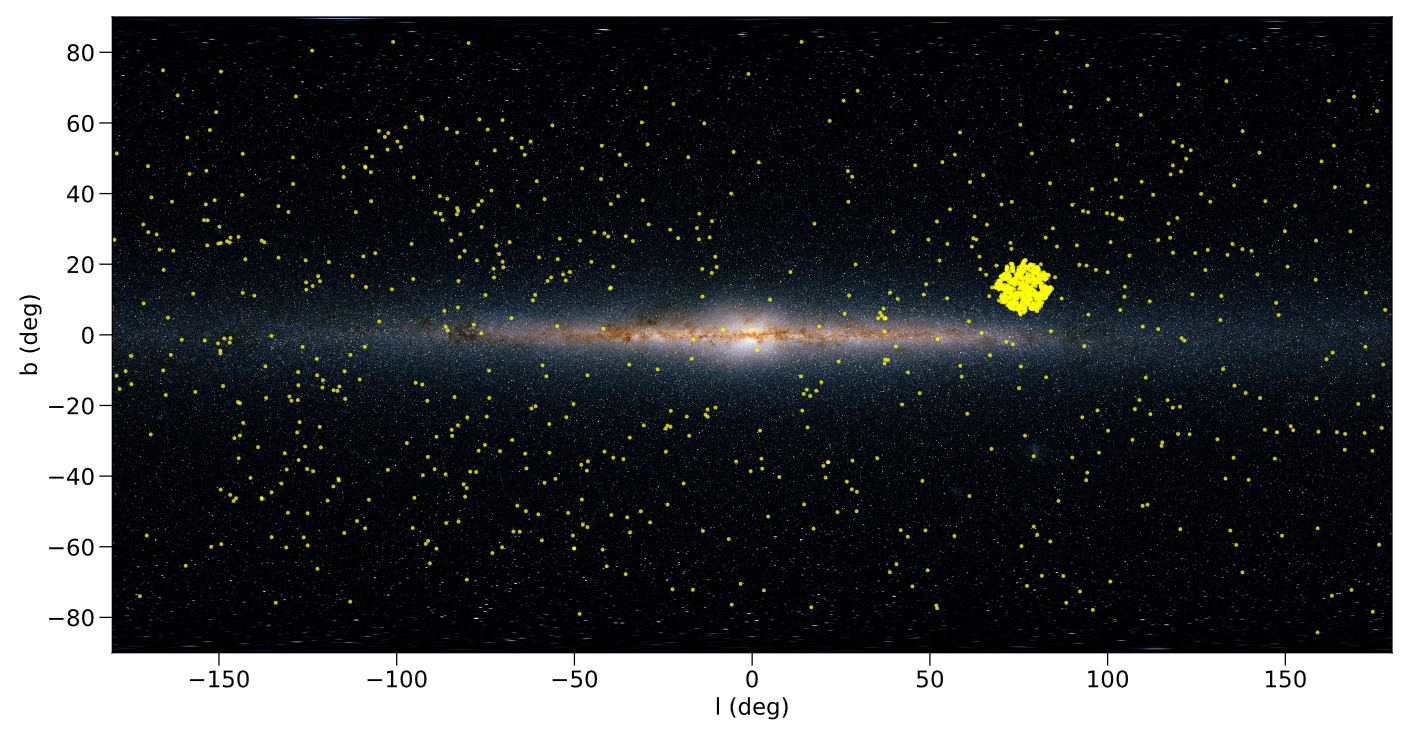
Figure 1: Sky coverage of the final sample of 1341 planet-hosting stars (yellow markers) shown in Galactic coordinates overlaid on the 2MASS near-infrared map (courtesy of ESA/Gaia/DPAC). The prominent overdensity corresponds to the Kepler mission (Borucki et al. 2010) footprint. (This is Fig. A.2. pf the submitted paper).
What Did We Find?
With our analysis, we were able to pinpoint the most likely birth radius of 1341 planet-host stars. Several interesting patterns appeared, as summarized below.
- Most planet-hosting stars in our sample likely formed at smaller Galactocentric radii than their current guiding radii. This seems to reflect the well known planet-metallicity correlation as the most metal-rich stars seem to have been formed in the inner regions of the Galaxy;
- However, there are differences depending on the type of companion around the star: Giant-planet hosts preferentially come from inner-Galaxy birth sites; brown-dwarf hosts span a broader, less localised range of birth radii; rocky-planet only systems show smaller radial excursions and less centrally concentrated birth radii; systems with rocky+giant planets are intermediate, retaining a stronger link to inner-disc birth environments than rocky-only systems (Fig. 2, left).
- We also find preliminary evidence that outward-migrators host more compact outer detected companions than inward-migrators. This may be an indication that stars formed in the inner disk loose the most distant planets when migrating to outer Galactic regions (Fig. 2, right).
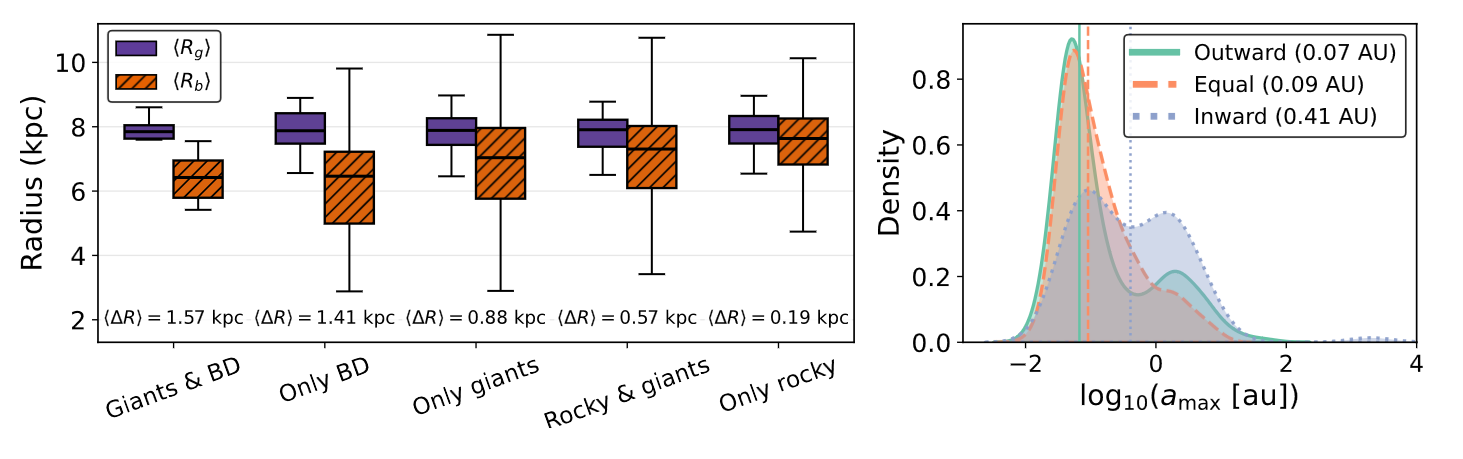
Figure 2: Left: Boxplots comparing the distributions of current (guiding) radius ⟨Rg⟩ and the birth radius ⟨Rb⟩ for stars hosting planetary systems grouped by planet-type category. Right: Gaussian kernel density distributions of semi major axis of the (amax) of the most distant planet for the distinct motion classes: outward, non- and inward migrators. Vertical lines indicate median values. (This is Fig. 1 from the related proceedings).
Why Does This Matter?
As the samples of stars known to host planets increase, some fundamental questions about the origin of planets start to emerge. One of them is whether there is a preferred Galactic region where planets are formed and, in particular, where planetary systems can remain stable for the time needed to develop life! Our study is a contribution to better understand these topics.
We show that stars with giant planets retain a strong connection to metal-rich inner-Galaxy birth environments. Stars with rocky-only systems are less centrally concentrated. The older ages of rocky and rocky+giant hosts, especially among outward migrators, make them useful reference populations for future habitability and technosignature searches.
A very interesting finding, that remains somewhat speculative because of biases in the discovery process of planet-host stars, is that the architecture of planetary systems may be affected by the migration history of the star. Those planetary systems formed around stars born in the inner Galaxy that migrate outwards may loose outer planets in the process.
This study is a continuation in our journey to explore more about the origins of stars in our cosmic neighbourhood. Expect to see more results coming soon!