Homogeneous analysis of high-resolution optical spectra for a sample of 135 giants in 14 bulge globular clusters
This paper is the second paper of the "Playing CHESS with stars" series. In the series, we present the homogeneous, precise and accurate (re-)analysis of archival UVES spectra of about 10 000 FGK-type stars. Here, we discuss atmospheric parameters and abundances for up to 14 different chemical elements in a sample of 135 giants belonging to 14 bulge globular clusters.
In this paper, we discuss the bulge globular clusters in the context of the phenomenon of multiple stellar populations and also what the abundances reveal about the chemical evolution of the bulge.
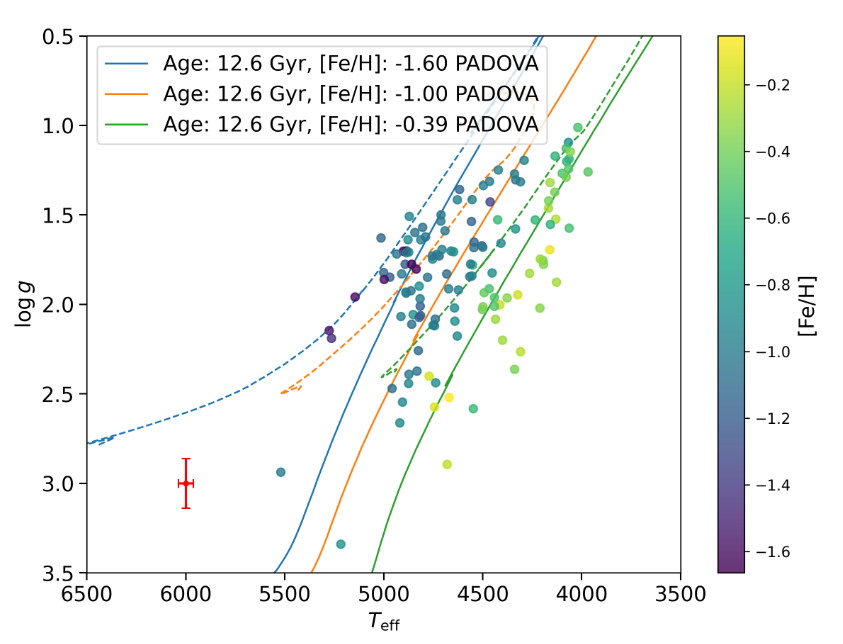
Figure 1: Diagram showing the temperature and surface gravity of our sample stars in comparison with the position of model tracks calculated for the age and metallicity of the clusters in our sample. The agreement between our determinations and the models demonstrate the high-quality of our results.
High-precision, homogeneous analyses of large globular cluster (GCs) samples are essential to improve our understanding of the GC metallicity distribution, as well as the origins of the clusters and the origins of their multiple stellar populations. There are several recent examples of such studies and our current analysis is part of an ongoing effort to further progress in this direction. This work is the first part of a homogeneous analysis of a large sample of high-resolution archival spectra of stars in GCs. Our analysis uses a new pipeline, the CHEmical Survey analysis System (CHESS, Martínez Fernández et al. 2025), designed to derive homogeneous chemical abundances from archival spectra. The high quality of our results is demonstrated in Fig. 1.
What Did We Find?
Bulge globular clusters are key tracers of the complex formation history of the Galactic bulge, as they retain information on its past star-formation episodes. Their chemical abundances serve as empirical “fossil records” of the early evolution of the bulge. The Galactic bulge was recognized as a distinct structural component of the Milky Way eight decades ago. Nevertheless, there is still no fully self-consistent model for the Galactic bulge formation.
Globular clusters mainly host two distinct populations: stars that have abundances similar to those of halo stars of the same metallicity (so-called first-generation stars) and stars that have enhanced abundances of N and Na and depleted abundances of O and C (second-generation stars). These chemical differences likely come from the evolution of stars from the first generation, but the nature of these polluters has not been determined yet.
The main results of our study are:- We serendipitously discovered a Li-rich giant with A(Li) = 1.68 in NGC 6723, which was hidden in the archival data. Lithium-rich giants are very rare in GCs, only 16 of them have been reported in total thus far. The star is a high-probability member of the cluster and its Na abundance indicates this is part of the cluster's first generation.
- Our sample includes both first- and second-generation stars, as indicated by the observed spread in Na abundances. Our limited investigation of Mg and Al indicates a possible anti-correlation in only one cluster, NGC 6522.
- Compared to halo clusters, the bulge clusters show a lower [alpha/Fe] plateau at low metallicity and a more gradual decline in [\alpha/Fe] toward higher metallicities.
- The Sc abundances are below solar and lower than in disk stars of the same metallicity. Questions about its nucleosynthesis remain and it is known to be underproduced by theoretical models. This observed difference between the GCs and the disk stars could be useful for constraining models of the nucleosynthesis of Sc.
- None of the clusters exhibit any significant spreads in heavy elements.
- Most clusters exhibit a flat ratio of [Ba/Eu] ~ 0.0, indicating a contribution from both s- and r-processes.
- Clusters of low metallicity, [Fe/H] < -0.5, show negative [Ce/Nd] ratios. These two elements have higher fraction of production by the r-process than Ba. This observation supports previous suggestions that these elements were predominantly produced by the r-process in these clusters.
Why Does This Matter?
Our results reveal several interesting features, including the discovery of a rare lithium-rich giant star in the cluster NGC 6723 and evidence for distinct stellar populations within these clusters. We found that bulge globular clusters have chemical patterns that differ in some respects from those of stars elsewhere in the Milky Way, particularly in the abundances of elements such as magnesium, calcium and scandium. These differences suggest that the central regions of our Galaxy experienced a somewhat different history of star formation and chemical enrichment when compared to the Galactic disk and halo.
Our measurements also provide interesting results about the different processes responsible for creating elements heavier than iron. The absence of significant variations in heavy-element abundances suggests that these systems formed from gas with a relatively uniform chemical composition. In addition, we see signs from a contribution from both s- and r-processes, indicating chemical enrichment from both low- and high-mass stars, respectively. We found some evidence of stronger contribution by the r-process in the metal-poor clusters. Together, these findings add information that can help us understand better the origins of the Milky Way.